
Cellon Clinic — Facial Fat Grafting
Facial Fat Grafting:
Why Each Zone Requires Its Own Strategy
Even with the same fat grafting procedure, the technical complexity, graft survival conditions, and expected outcomes vary significantly depending on the treatment area. Here's an in-depth look at how Cellon Clinic's PAMI Fat Grafting tailors its approach to each zone.
Why Zone Matters
"Fat grafting is all the same" — and why that's a myth worth addressing

One of the most common misconceptions among people first considering facial fat grafting is this: "Isn't it basically the same no matter where you take the fat from or put it?" The short answer — no, it isn't.
Every area of the face differs in skin thickness, subcutaneous fat layer depth and structure, vascular distribution, proximity to muscle, and lymphatic flow direction. Even fat processed with the same purification technique needs to be injected at different depths, in different volumes, with different pressures, and through different cannula sizes depending on the zone.
At Cellon Clinic, when performing PAMI (Pure Autologous Microfat Injection) fat grafting, these anatomical differences between zones form the very foundation of our treatment strategy. Today, we'll walk you through how fat grafting differs across each area of the face — and why certain zones call for extra caution.

Zone by Zone
How Does It Differ by Area — Starting with the Most Effective Zones
Let's start with the areas where fat grafting tends to deliver more predictable results and where treatment strategies are relatively well established.
Temples
The temples are typically the first area to hollow out as we age. The subcutaneous fat layer here is relatively thick, providing a stable space for injection. Because the conditions for fat survival are favorable, results tend to be more predictable, and natural-looking volume restoration is achievable. That said, avoiding overfilling is key.
Cheeks (Mid-Face Fat Compartments)
Volume loss in the mid-face is one of the main reasons a face can look tired or drawn. When the fat compartments above the SMAS layer are well understood and fat is injected layer by layer with precision, an overall lifting effect across the face can also be achieved. A thorough anatomical understanding is what truly separates good outcomes from great ones here.
Nasolabial Folds
Rather than injecting directly into the fold itself, a more effective approach is restoring the surrounding volume to indirectly soften the crease. Before proceeding, it's essential to determine whether the fold is caused by loss of skin elasticity or volume depletion — the root cause shapes the entire strategy.
Forehead
Fat grafting to the forehead creates a natural, rounded contour in areas that appear flat or sunken. Injection can be placed either above the periosteum or within the subcutaneous fat layer, and balancing volume between the central and lateral forehead is what determines how natural the result looks. Overfilling can produce an unnatural silhouette, so volume control is everything.
Jawline & Chin
Adding volume to a small or recessed chin can rebalance the overall facial proportions. Even minor deviations in injection placement can distort facial harmony, so a thorough three-dimensional analysis from both the front and side is essential beforehand.
Perioral Area (Around the Lips)
This area addresses hollowing above or below the lips and downturned corners of the mouth. Results tend to last longer than hyaluronic acid fillers, but because the mouth is in near-constant motion, it's important to closely monitor how well the grafted fat maintains its shape after it settles.
Caution Zone
Areas That Require Extra Caution — Higher Difficulty or Greater Risk
Not every area of the face can be approached the same way with fat grafting. The zones below require far more precise anatomical judgment, and the gap between expected and actual results can be significant.
Upper Eyelid Area
Fat grafting to the upper eyelid is one of the most delicate procedures on the face. The skin here is extremely thin, and the surgeon must have a precise understanding of the orbital fat relationship, lymphatic flow, and vessel locations. Overfilling can lead to prolonged swelling or uneven results, while underfilling produces minimal effect. Because the margin for error is so narrow, the surgeon's experience and judgment directly determine the outcome.
Under-Eye Area (Tear Trough)
Many patients consider fat grafting for tear trough hollows, but this area can actually produce unnatural results depending on the lacrimal pathway, whether there is lower orbital fat protrusion, and the structure of the inferior orbital rim. A careful comparison with filler indications is essential, and in some cases a different approach may be more appropriate than fat grafting altogether.
Around the Nose
The nose has an extremely complex vascular network. Fat grafting to the nasal dorsum or nasal tip is generally contraindicated due to the risk of vascular occlusion. This area should only be approached in very select cases, with exceptional care and strict limitations on indications.
Previously Over-Treated Areas
Adding more fat to areas that have already been overfilled from prior procedures can make things worse rather than better. The existing graft survival, any fibrosis, and surface irregularities must all be thoroughly assessed before forming a new treatment plan.
"In fat grafting, what matters more than the volume placed is where it's placed, in which layer, and with what precision. Simply filling volume without a thorough understanding of the anatomy for each specific zone can lead to results that look unnatural."
Cellon Clinic — PAMI Fat Grafting Principles
PAMI Approach
How PAMI Fat Grafting Takes a Tailored Approach by Treatment Area
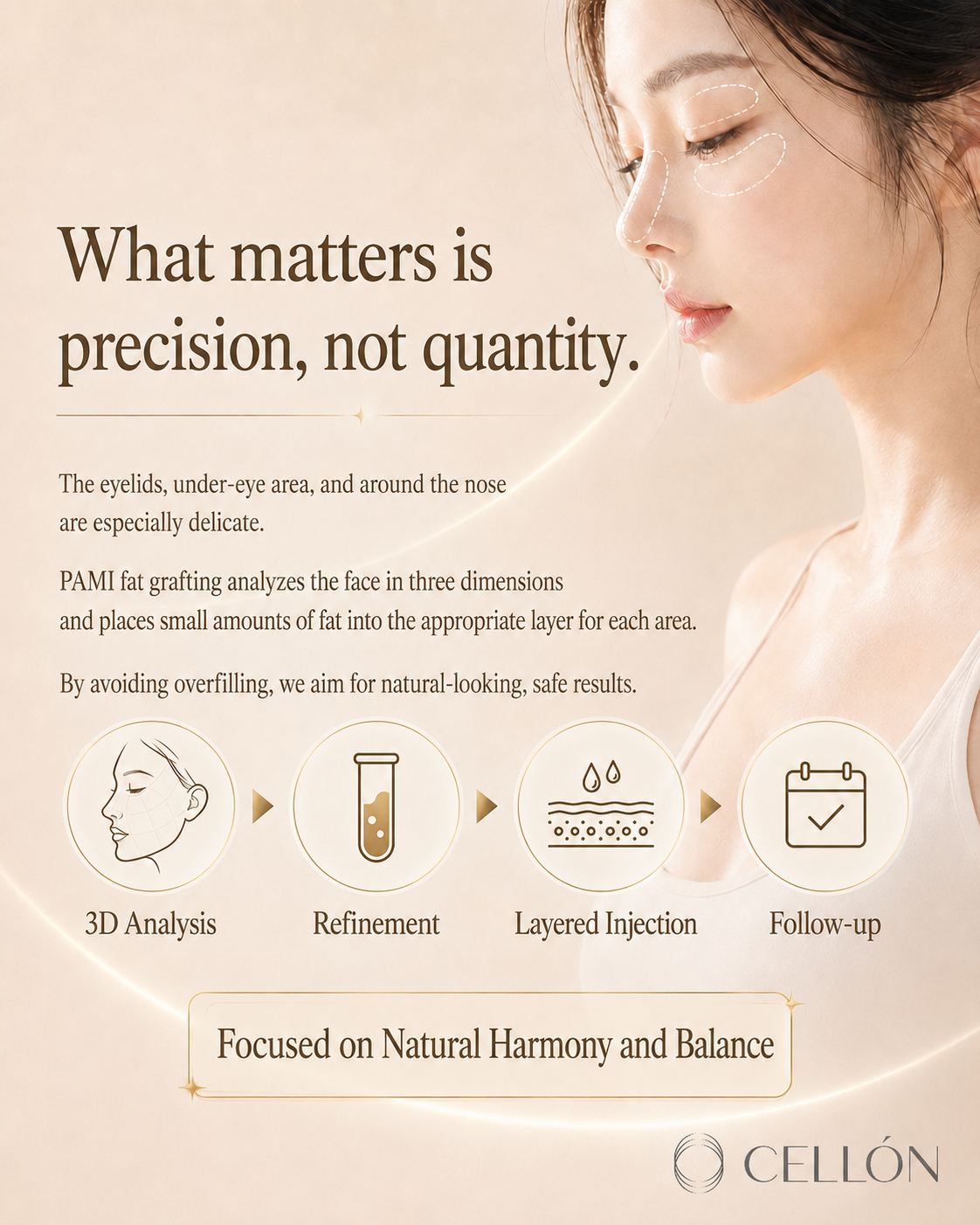
PAMI (Pure Autologous Micro-fat Injection) is a technique designed to minimize cellular damage during fat processing and refine harvested fat into an optimal state for engraftment. But the technique itself is only half the equation — the injection strategy for each facial area is equally important.
Precise Volume Analysis — Assessing Volume Loss by Area
The entire face is analyzed three-dimensionally from the front, side, and diagonal angles. Identifying exactly where volume has been lost, and where the boundaries of existing fat compartments lie, is essential before determining how much to inject and at which layer.
Donor Site Selection — Determining Fat Quality
The density and characteristics of fat cells vary depending on the harvest site. High-quality fat is collected from areas such as the abdomen, flanks, and inner thighs, then refined using the PAMI method with minimal processing. Reducing cell damage at this stage has a direct impact on the final engraftment rate.
Choosing the Right Cannula and Injection Layer for Each Area
Delicate areas like the under-eye region require a fine cannula to disperse small amounts evenly. Areas with more space, such as the cheeks or forehead, are injected in multiple layers to ensure fat cells have sufficient access to nearby blood vessels for nourishment. Selecting the wrong injection layer can lead to uneven engraftment.
Volume Control — Preventing Overfilling
There's a common misconception that injecting more fat leads to better results. In reality, overfilling causes the fat cells at the center of the graft to be cut off from blood supply, leading to necrosis — and potentially lumps or calcification. The optimal volume for each area is carefully calculated and strictly followed.
Follow-Up Monitoring — Confirming Engraftment and Planning Touch-Ups
The first 3 to 6 months are the engraftment stabilization period. During this time, swelling subsides and the grafted fat settles into its final position. If a touch-up is needed, it is planned only after this period has passed and a thorough evaluation has been completed.
Common Misconceptions
Common Misconceptions About Fat Grafting
In consultations, we often hear the same misconceptions come up again and again. Let's clear a few of them up.
"The more you inject, the longer it lasts, right?"
As mentioned earlier, over-injection actually creates unfavorable conditions for fat survival. Fat cells receive nutrients and oxygen through diffusion from surrounding blood vessels — if too much fat is injected, oxygen simply can't reach the cells at the center. The result is a lower survival rate, along with potential lumps or unevenness.
"Why mention touch-ups? Can't you just do it all in one session?"
It's genuinely difficult to predict the exact final volume needed from the start, and survival rates vary from area to area. After seeing how the first session settles, adding a small amount where needed produces results that are far more natural — and far safer.
"It's my own fat, so there can't be any side effects, right?"
Because it's your own tissue, the risk of immune rejection is essentially zero — but risks such as incorrect placement, over-injection, infection, and post-settlement asymmetry still exist. "Autologous" does not automatically mean "risk-free."
FAQ
Frequently Asked Questions

Cellon Clinic — Consultation
Find the Right Strategy for Your Face —
See What Works for You
With facial fat grafting, the results come down to where, how much, and how it's placed. At Cellon Clinic, we provide a precise area-by-area analysis to guide you toward the approach that's right for your face.
Chat with Us on WhatsApp