
Facial Fat Grafting · Cellon Clinic
Grafted fat doesn't disappear —
So why does your face look different as the years go by?
"Once grafted, it's permanent" and "it all fades after a few years" — neither statement is completely true. To accurately predict your fat grafting results, you need to understand both how engraftment works and how the face ages over time.
What Does "Semi-Permanent" or "Long-Lasting" Actually Mean?
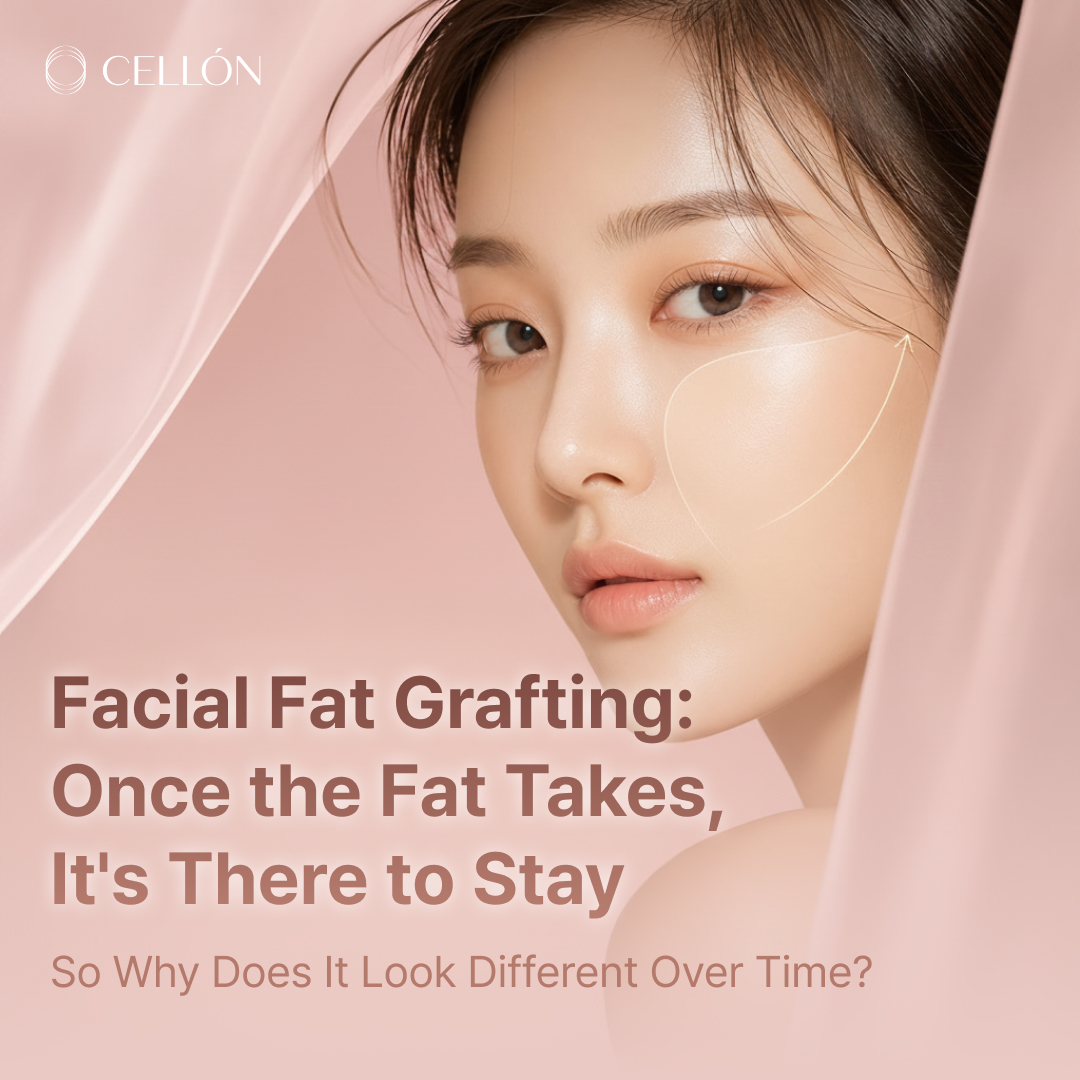
When researching facial fat grafting, one phrase you'll encounter almost everywhere is "semi-permanent results." Yet very few sources take the time to explain exactly what that means. Left with only a vague impression of "it lasts a long time," many patients find themselves confused years later when their face looks different — wondering whether the procedure somehow failed.
To be precise, here's how to think about it. Fat cells that successfully engraft after transplantation continue to exist as living cells within your own body. They are not reabsorbed or lost. From this perspective, calling the result "permanent" is not inaccurate.
That said, there is a reason results can look different over time — and it has nothing to do with the grafted fat diminishing. Rather, it is the face surrounding that fat that changes. Skin begins to sag, supporting ligaments loosen, and the underlying bone structure shifts subtly with age. These natural aging processes alter the overall volume and contour of the face.
"When patients feel like they've lost volume a few years after fat grafting, it is far more often due to changes in the surrounding tissue — decreased skin elasticity, laxity in the facial support structures — rather than the grafted fat being reabsorbed. Distinguishing between these two is the first and most important factor in deciding whether a touch-up is warranted."
In short, the engraftment outcome of fat grafting itself is maintained — but the face it lives in continues to change with time. Confusing these two things creates a significant gap between expectations and reality when it comes to evaluating your results.
engraftment to fully stabilize
fat graft survival rate
engrafted fat cells last
The reason survival rates vary across such a wide range — 30 to 70% — is that numerous variables are at play beyond technical skill alone, including the patient's circulation, the thickness of the grafting layer, and the size of the fat particles used. Looking at these numbers in isolation, it's easy to walk away thinking "half of it gets absorbed." But what truly matters is how long the cells that do survive continue to persist after engraftment is complete — and those cells do not disappear.
How Does Your Face Change Over Time After Fat Grafting?
Immediately After — Swelling and Over-Correction Phase
Right after the procedure, swelling from tissue response adds to the volume, making the results look fuller than they actually are. This is not your final outcome. In many cases, the treatment is intentionally designed with over-correction — adding slightly more volume to account for expected absorption during the engraftment process. As the swelling subsides and grafting progresses, the face settles into a more natural shape.
1–3 Months — Engraftment in Progress, Volume Stabilizing
This is the period when the transplanted fat cells begin forming connections with surrounding tissue and blood vessels in order to survive. During this time, fat that fails to graft is absorbed by the body, leaving only the successfully integrated cells behind. It's normal to feel concerned as the volume appears to decrease — but this is all part of the process. It's best to reserve judgment during this phase.
3–6 Months and Beyond — Engraftment Complete, Final Results Visible
From this point on, your results stabilize. The surviving fat cells become a permanent part of your body, responding naturally to changes in weight and metabolism going forward. This is what's known as "permanent engraftment," and it's the appropriate benchmark for evaluating whether a touch-up is needed.
Several Years Later — Aging Alongside Your Face
The grafted fat itself remains intact. However, as collagen in the skin diminishes and the retaining ligaments that anchor facial skin to underlying bone gradually loosen, the overall facial structure changes. In some cases, this can make the volume appear to have "disappeared" — but this is not the loss of the transplanted fat. It is simply the natural aging of the face itself. Before deciding on a touch-up, it's important to accurately identify the true cause of the change.
The Four Real Reasons Fat Can Seem to "Disappear"
If you feel like your facial volume has noticeably decreased several years after fat grafting, it's usually not because the transferred fat was absorbed. What you're seeing is the face itself changing as a three-dimensional structure due to natural aging. Understanding these changes makes it much easier to grasp why your appearance can shift over time — even when the graft is still in place.
Loss of Skin Elasticity
As collagen and elastin levels decline, the skin begins to loosen and sag. Even if the grafted fat remains exactly where it was placed, the skin draped over it loses its firmness — creating the visual effect of reduced volume. This is precisely why maintaining skin quality is just as important as the graft itself for preserving long-term results.
Relaxation of Retaining Ligaments
The retaining ligaments that anchor facial skin to the underlying skeleton gradually loosen with age, allowing both skin and fat to migrate downward under gravity. This descent affects both the position and the apparent volume of grafted fat. Hollowing beneath the eyes and deepening nasolabial folds are classic examples of what this looks like in practice.
Subtle Changes in Bone Structure
Bone ages too. The facial skeleton — including the cheekbones, jawbone, and orbital rims — gradually resorbs over time, shifting the position and volume of the soft tissue resting on top of it. This happens regardless of whether fat grafting was performed; it's simply part of natural aging. It's one of the core reasons why volume planning that accounts for skeletal change matters so much.
Response to Weight Fluctuation
Engrafted fat cells behave exactly like the rest of your body's fat cells. If you lose weight, volume at the treated site can decrease as well — and if you gain weight, it may increase. Significant fluctuations in body weight directly impact your grafting results, so maintaining a stable weight before and after the procedure is key to keeping outcomes consistent over time.
Because all four of these changes work in combination, it's completely natural for your face to look different as years pass after fat grafting. What really matters is how these changes manifest. The naturalness of your results years down the line depends heavily on how precisely the procedure was designed — and whether the anticipated trajectory of aging was factored in from the start.
How PAMI Fat Grafting Addresses These Challenges
PAMI Fat Grafting isn't simply focused on "graft survival rates." The approach is to design volume at the anatomical layer level so that results remain natural over time. The core of PAMI lies in planning not just for volume today, but for how your face will change years down the road.
The Conventional Fat Grafting Approach
- Graft volume set with maximum volume gain as the primary goal
- Focused injection into a single or double subcutaneous layer
- Relies on overcorrection to adjust final results after engraftment
- Increased risk of sagging and asymmetry as aging progresses
- Difficult to predict the timing and scope of touch-ups
The PAMI Fat Grafting Approach
- Precision multi-layer grafting across individual anatomical fat compartments
- Combined application of micro-fat and nano-fat
- Volume distribution designed with the direction of aging in mind
- Expected skin rejuvenation through adipose-derived stem cell activity
- Improved predictability for touch-up intervals and scope
Cellon FAMI Fat Grafting — Layered Design and a Regenerative Medicine Approach
The volumetric structure of the face is not a single layer of fat. In reality, it consists of a superficial fat compartment just beneath the skin, a deep fat compartment above the fascia, and a sub-muscular fat compartment below that. Each layer ages at a different rate and shifts in a different direction under gravity.
With FAMI fat grafting, we first map this layered structure precisely, then design exactly which compartment receives how much fat and at what particle size — all tailored to each patient's individual anatomy. The greater the precision of that design, the more predictably and naturally the results evolve even years after the procedure.
Why We Use Both Microfat and Nanofat
In FAMI, Microfat and Nanofat are used for distinct purposes: Microfat for structural volume, and Nanofat for skin regeneration. Nanofat is rich in Adipose-derived Stem Cells (ADSC), which can help improve the elasticity and texture of the skin surrounding the graft site. Rather than simply filling volume, the goal is to improve the grafting environment itself — and that is the fundamental difference between regenerative medicine-based fat grafting and conventional approaches.
Cellon Clinic — Cheongdam Designated Advanced Regenerative Medicine Hospital
Cellon Clinic is a Cheongdam Designated Advanced Regenerative Medicine Hospital certified by the Ministry of Health and Welfare. We apply rigorous, systematic standards to stem cell-based regenerative procedures, and in fat grafting specifically, we integrate a regenerative medicine perspective that goes well beyond basic volume correction. All consultations and procedures are performed personally by lead physician Dr. Kang Seung-hoon, with consistent clinical standards applied to both domestic patients and international medical tourists alike.
For fat grafting results to remain natural over time, today's volume design must be paired with a plan that accounts for how the face will continue to change in the years ahead. That perspective is the foundation of Cellon FAMI Fat Grafting.
Frequently Asked Questions
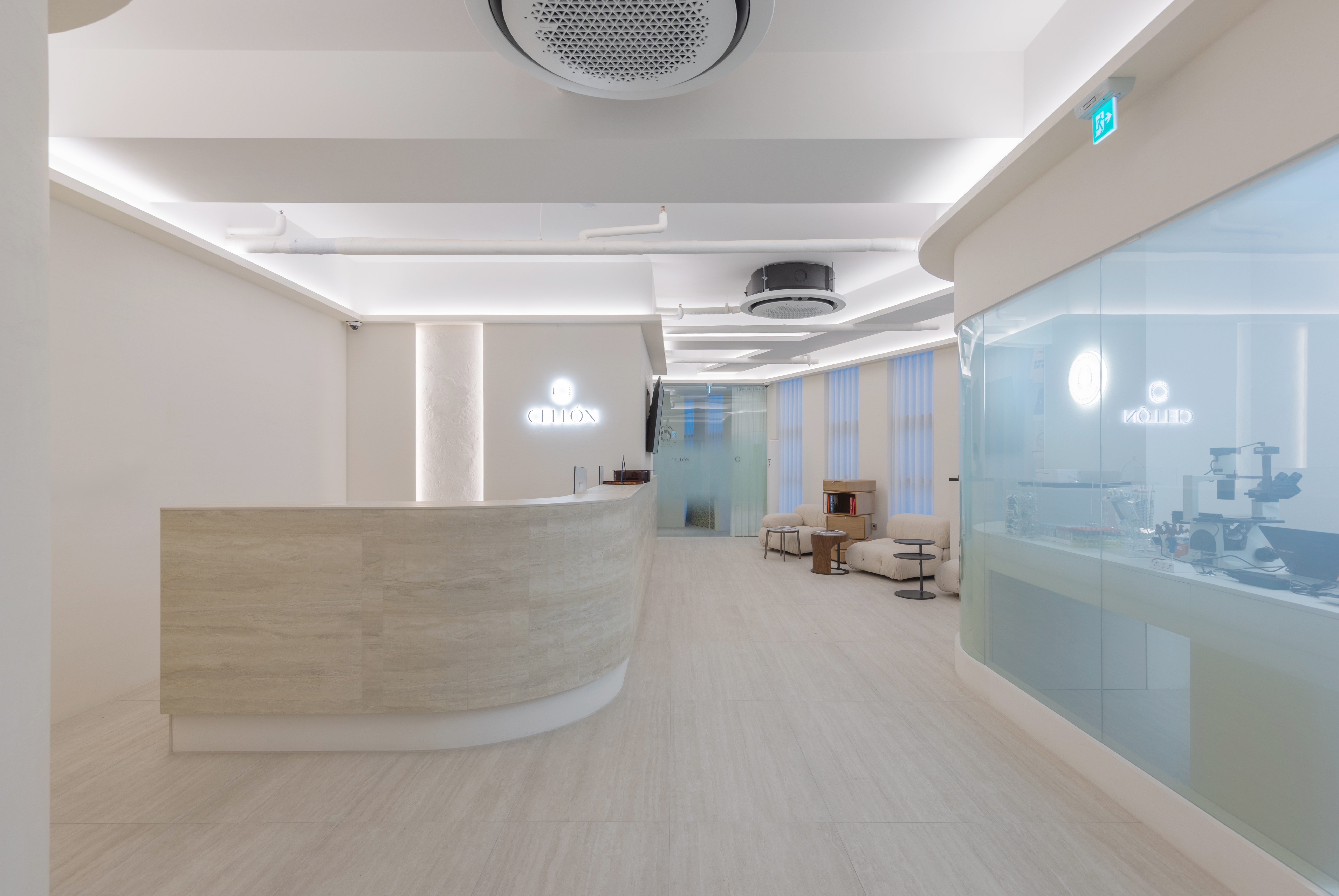
Fat Grafting Results Designed to Last — Not Just for Now, But for Years to Come
At Cellon Clinic, our PARMI fat grafting consultations go beyond simply adding volume — we take into account the long-term trajectory of your aging process.
We craft a personalized plan tailored to your unique facial structure and natural aging pattern.