

← Back to Articles
No. 03 May 28, 2026
Fat Grafting Q&A

If Your Face Looks More Sagging
and Fuller After Fat Grafting

If the facial fat grafting you hoped would make you look more beautiful has instead led to sagging and over-volumization, it may not simply be bad luck — it could be a sign that the treatment plan itself needs to be re-examined. The director of Cellon Clinic explains honestly what causes this and what the right approach looks like.

Why Fat Grafting Can Actually Make Your Face Sag

The real reasons behind sagging and facial enlargement after fat grafting — Q&A

Fat grafting is a procedure that can restore natural volume while delivering anti-aging benefits at the same time. Yet many patients find their skin looks more sunken or their facial contours heavier and larger after treatment. In most cases, this isn't a problem with the procedure itself — it comes down to how it was planned and performed. Here are the four main reasons why.
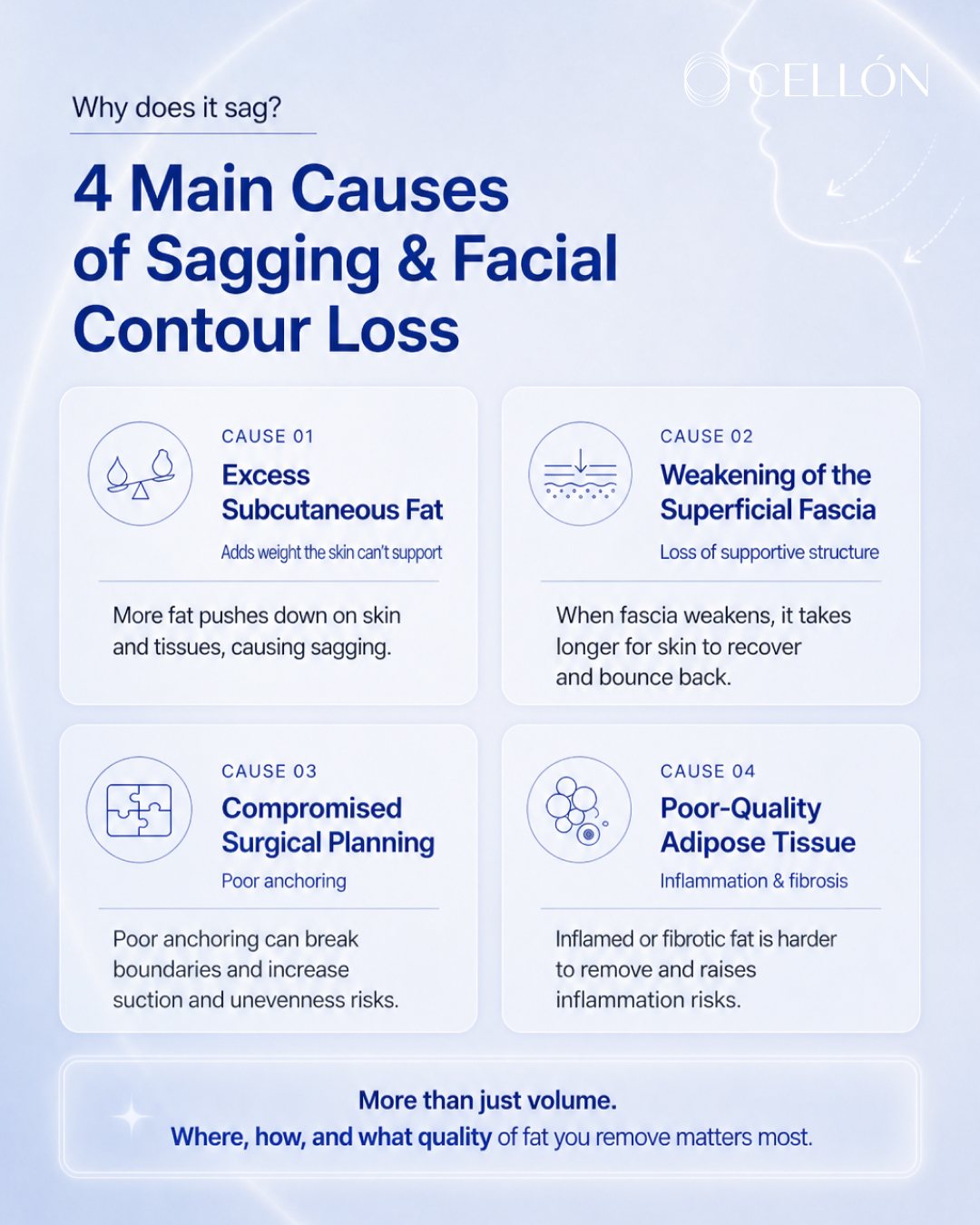
CAUSE 01
Overfilling — More Than the Skin Can Handle
It's a common misconception that more fat equals a younger, firmer look. When fat is injected beyond what the skin's elasticity can support, the added volume pulls the skin and underlying tissue downward, which can actually worsen sagging. This is especially true when excess fat is placed in the lower cheeks, around the nasolabial folds, or near the corners of the mouth — areas that then tend to drop and give the face a rounded, heavy appearance.
CAUSE 02
Superficial Injection — Too Close to the Surface
Concentrating fat in the subdermal layer just beneath the skin may look firm at first, but over time gravity pulls it downward. For results that stay naturally positioned long-term, fat needs to be distributed across the deeper fat compartments of the face. The depth at which fat is placed plays a critical role in whether sagging occurs down the line.
CAUSE 03
Ignoring Anatomical Compartments — The Risk of Bulk Injection
The face is divided into dozens of distinct fat compartments, each with its own aging rate and structural support. When these boundaries are disregarded and fat is deposited in large boluses or concentrated in a single area, the graft absorbs unevenly over time — leading to irregular surface texture and asymmetric sagging.
CAUSE 04
Poor-Quality Fat — A Recipe for Inflammation and Fibrosis
Fat that hasn't been properly purified after harvesting contains oil, blood, and damaged cell debris. Once injected, these impurities can trigger an inflammatory response that leads to hardening or fibrosis — resulting in an uneven texture and skin laxity. The quality of the fat graft is one of the most critical variables determining how the final result looks.
“In facial fat grafting, what matters isn't just how much fat is used — it's where it's placed, at what depth, and with what quality of fat. The difference in outcomes ultimately comes down to anatomical understanding and fat processing technique.”
Cellon Clinic Medical Director

What kind of fat grafting lasts without sagging?

Fat grafting that maintains natural volume without sagging over time is built on principles that stand apart from common poor practices. Let's compare what makes the difference.

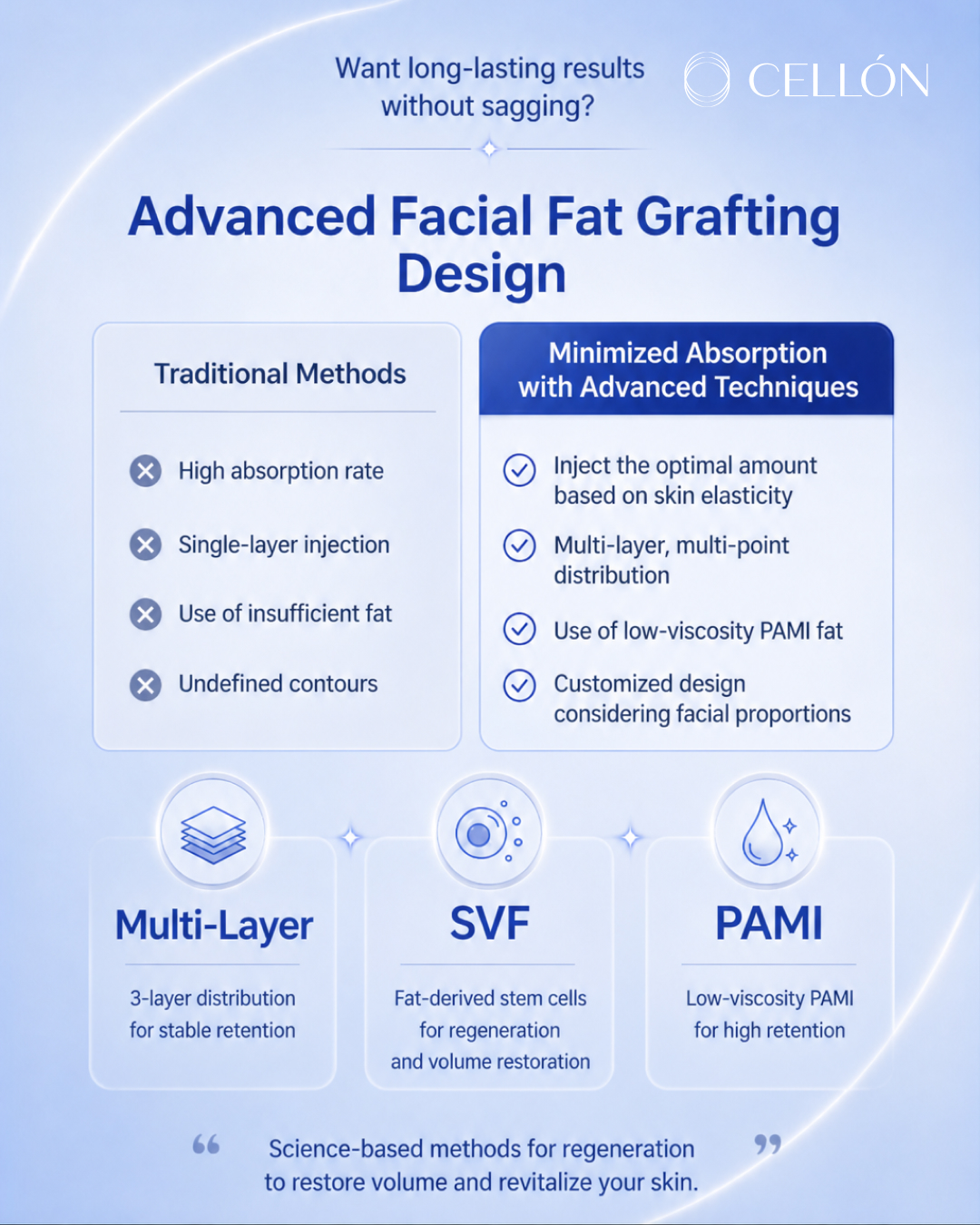
Approaches That Cause Sagging & Complications
  • Excessive concentrated injection for immediate volume
  • Single-layer superficial injection without assessing skin elasticity
  • Using inadequately purified centrifuged fat as-is
  • Filling only the cheek center, making the face look round and oversized
  • Injection design that ignores facial fat compartment boundaries
The Right Approach to Minimize Sagging
  • Precise, divided micro-injections based on skin elasticity assessment
  • Multi-layer, multi-point dispersed injection based on deep fat compartments
  • High-purity PAMI-method purified fat
  • Three-dimensional volume design with overall facial proportions in mind
  • Stem cell-enriched fat — enhanced regeneration and graft survival rate
Facial Fat Grafting at Cellon Clinic — A Regenerative Medicine Approach

Cellon Clinic is a Ministry of Health and Welfare-designated Cheongdam Designated Advanced Regenerative Medicine Hospital, combining stem cell therapy with high-purity fat grafting techniques. Rather than simply filling in volume, our approach actively creates an environment that supports skin regeneration — a distinction that sets us apart. Every procedure is personally designed and performed by Chief Director Kang Seung-hoon.

1
Precision Fat Harvesting — Securing Viable Adipocytes
Fat is harvested from donor sites best suited to each patient — commonly the abdomen, thighs, or flanks. Using low-pressure techniques and refined instruments to prevent cell damage is the critical first step that directly determines graft survival rates. Purification begins immediately after harvesting, with cell viability management in place from this earliest stage.
2
PAMI Processing — High-Purity Purification
The harvested fat undergoes purification using the PAMI (Pure Adipose Micro Injection) method. This process removes oil layers, blood, and damaged cells, selecting only the highest-viability adipocytes. The resulting fat contains significantly fewer inflammatory substances, reducing the risk of post-injection swelling and fibrosis while helping maintain a smooth, even skin texture.
3
SVF Stem Cell Enhancement — Boosting Regenerative Power
As a Designated Advanced Regenerative Medicine Hospital, Cellon Clinic is able to isolate and utilize SVF (Stromal Vascular Fraction) — a cell population rich in adipose-derived stem cells — alongside the fat graft. Stem cells support vascular regeneration and skin elasticity at the injection site, improving graft survival rates while enhancing the overall texture of the treated skin. Volume restoration and skin regeneration work hand in hand.
4
Anatomical Multi-Layer Distribution — Three-Dimensional Facial Design
Based on a thorough understanding of facial fat compartment anatomy, fat is distributed evenly across the deep, mid, and superficial layers. By avoiding concentration in any single layer, the risk of sagging is minimized. Because each injection is designed with the face's overall proportions and three-dimensionality in mind, results look naturally balanced — not just filled in, but thoughtfully redistributed to harmonize areas of volume loss and excess.
多層
Deep · Mid · Superficial
3-Layer Distribution
SVF
Adipose-Derived Stem Cells
Engraftment & Regeneration Synergy
PAMI
Pure Adipose Micro Injection
High-Purity Purification Method

Fat Grafting: Frequently Asked Questions

We've compiled the questions we hear most often during consultations. From sagging and volume concerns to lifestyle habits, here are our honest answers.

QAfter fat grafting, does my face look larger because of swelling — or has it actually gotten bigger?
In the first two weeks after the procedure, it's completely normal for your face to look a bit fuller due to swelling — most of that volume is inflammation that will gradually subside. If, however, your face still looks oversized, heavy, or droopy after two to three months, the cause may be overfilling or fat injected at an improper depth. In that case, a follow-up consultation to identify the issue is the right first step. The three-to-six-month mark — when swelling has fully resolved and engraftment is largely complete — is the appropriate time to evaluate your final result.
QIf the grafted fat gets absorbed, will the sagging go away with it?
Some of the grafted fat is naturally absorbed over time, and as volume decreases, mild sagging may improve along with it. However, skin that has already been stretched does not regain its elasticity on its own. In cases of significant sagging, combining the treatment with HIFU (High-Intensity Focused Ultrasound) or a lifting laser may be necessary. If volume loss is substantial, a secondary fat grafting session may also be needed. Your specific situation can only be accurately assessed through an in-person consultation.
QIf I go on a diet, will the grafted fat disappear along with the rest?
Engrafted fat cells behave exactly like the rest of your body's fat cells. This means that significant overall weight loss can reduce volume in the grafted areas, while weight gain can cause them to expand. Dramatic weight fluctuations after the procedure can affect how long your results last, so maintaining a stable weight before and after treatment is key to preserving the outcome long-term.
QWhat is the difference between fat grafting and fillers? Which one is better?
Fillers use medical materials such as hyaluronic acid, delivering immediate results with a short treatment time. Fat grafting, on the other hand, uses your own tissue — meaning no foreign-body reaction — and results can last semi-permanently once engrafted. The trade-off is that fat grafting involves a harvesting step and engraftment rates vary between individuals. Rather than one being universally superior, the right choice depends on your age, skin laxity, and desired volume, which is why a consultation is the best starting point. In some cases, both approaches are used in combination.
QWhen can I resume exercise after fat grafting?
Light walking is generally fine from about two to three days post-procedure, but strenuous cardio or strength training should be reintroduced gradually, no earlier than three to four weeks out. In the early stages, a spike in blood flow can worsen swelling and bruising and may interfere with initial fat engraftment. For a personalized timeline, it's always safest to consult your doctor based on how your individual recovery is progressing.
Cellon Clinic — Cheongdam Designated Advanced Regenerative Medicine Hospital

Concerned About Your Fat Grafting Results?
Start with a Consultation at Cellon Clinic

Whether you're dealing with sagging, overfilling, or asymmetry after fat grafting — or you simply want a well-planned procedure from the very beginning — you're in the right place. Chief Medical Director Dr. Kang Seung-hoon will personally consult with you and answer all your questions.

Chat with Us on LINE

This content is intended for informational purposes only. Results may vary depending on individual body condition and health status. Please consult a qualified medical professional for an accurate diagnosis and personalized treatment plan.