
What really determines the outcome
of fat grafting?
Autologous fat grafting is far more than simply adding volume. Because it involves transplanting living cells, every stage of the process — from how fat is harvested and processed, to the depth of injection and post-procedure care — directly shapes your final result. Once you understand the science behind graft survival, it becomes clear why the same procedure can look so different from one patient to the next.
Fat Grafting Means Transplanting Living Tissue
When it comes to restoring volume to the face, many people think of hyaluronic acid fillers and autologous fat grafting in the same breath. Both treatments fill in areas that have lost volume, so they can seem similar on the surface — but the underlying mechanisms are completely different.
Hyaluronic acid fillers are synthetic materials that gradually break down in the body over time. They offer temporary results, and once the filler is absorbed, the area returns to its original state. Autologous fat grafting, on the other hand, involves harvesting fat tissue from the patient's own body and transferring it to the desired area. When the transplanted cells form new blood vessels and integrate with the surrounding tissue, they create volume that can last for the long term.
This process is the key to everything. When transplanted fat cells begin receiving a blood supply, it's called angiogenesis. Cells that successfully establish this blood connection survive and "engraft," while those that don't are gradually reabsorbed or die off. The engraftment rate, in essence, comes down to how many of the transferred fat cells manage to connect with blood vessels and survive.
This biological process is influenced by every stage of the procedure — how the fat is harvested, how it's processed, which tissue layer it's placed into and with what technique, and even the recovery environment after the procedure. All of these factors play a role in whether the cells ultimately survive.
Three Stages That Determine Survival — Harvesting, Processing, and Injection
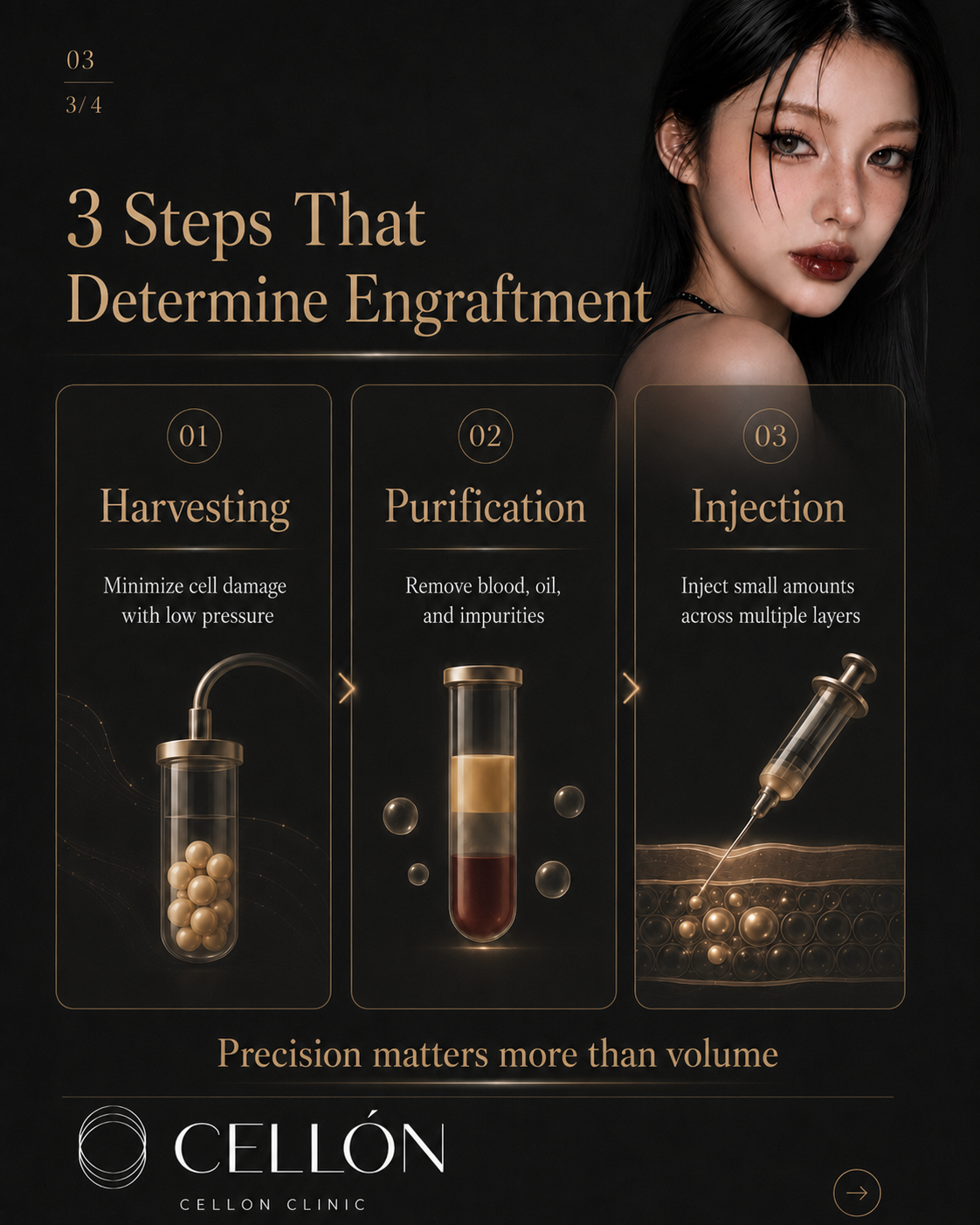
Autologous fat grafting involves three core stages: harvesting, processing, and injection. How well the fat cells are preserved at each stage ultimately determines the final survival rate. If fat cells are damaged at any one stage, the effects carry through every stage that follows.
-
1
Harvesting — It All Starts With Protecting the Cell Membrane
When fat is collected from donor sites such as the abdomen, thighs, or flanks, excessive suction pressure can physically damage the fat cell membranes. Once a cell membrane is compromised, the fat cell loses its ability to form new blood vessels after grafting and is simply reabsorbed by the body. Gentle low-pressure suction and the right cannula size are the first variables in cell viability — and that includes the speed, angle, and precision of every movement during extraction.
-
2
Processing — Refining to Maximize the Proportion of Viable Cells
Harvested fat contains far more than just living fat cells — it also carries blood, oil, excess fluid, necrotic cell debris, and connective tissue. The processing stage involves purifying this mixture through centrifugation or washing. The higher the proportion of viable cells remaining after processing, the greater the chance of successful engraftment. Centrifuge speed, duration, and careful management of exposure time after processing all need to be precisely controlled.
-
3
Injection — Distributed Placement Is the Key to Survival
When injecting purified fat, placing too much in a single area overwhelms the local blood supply. The cells at the center of a large graft deposit can be cut off from oxygen and nutrients before they ever connect to a blood vessel — leading to necrosis. To prevent this, small amounts of fat must be distributed evenly across multiple layers and in multiple directions. Creating enough space and vascular access for each cell to connect with a nearby capillary is where the expertise of a skilled practitioner truly makes the difference.
"The outcome of fat grafting depends just as much on how well the cells survive the harvesting and processing stages as it does on the injection itself. Preserving as many viable cells as possible before they ever reach the treatment site — that is the foundation of a high survival rate."
— Dr. Kang Seung-hoon, Chief Director of Cellon Clinic
What Sets FAMI Fat Grafting Apart from Conventional Fat Transfer
FAMI (Fat Autograft Muscle Injection) differs from standard fat grafting in one fundamental way: instead of depositing fat into the subcutaneous layer, it places fat directly into the muscle tissue. That difference in depth matters more than it might seem — and it all comes down to how grafted cells survive.
Muscle tissue is far more vascularized than the subcutaneous fat layer. For the transplanted fat cells, this means they're placed in an environment where blood supply can be established quickly. The faster early angiogenesis occurs, the better the odds that nutrients reach the cells before necrosis sets in.
Conventional Fat Grafting
Subcutaneous Placement
- Fat deposited into the subcutaneous layer
- Relatively sparse vascular distribution
- Some degree of reabsorption is expected
- Well-suited for broad volume restoration
- Lower demand for anatomical precision
FAMI Fat Grafting
Intramuscular Placement
- Fat placed within highly vascularized muscle
- Favorable early blood supply environment
- Natural, three-dimensional volumization
- Requires deep knowledge of facial anatomy
- Demands precision and advanced technique
That said, FAMI must be performed with a thorough understanding of facial muscle positions and the paths of surrounding vessels and nerves. Without that anatomical expertise, the technique can pose serious risks — which is why extensive clinical experience is essential for safe execution. Deciding which areas to treat with FAMI versus conventional subcutaneous grafting is itself a judgment call that requires specialist-level knowledge.
At Cellon Clinic, we assess the structural characteristics of the entire face alongside each patient's tissue condition to determine the optimal placement depth for every zone. Thoughtfully combining FAMI with subcutaneous grafting based on the specific area is central to achieving results that look genuinely natural.
The Stem Cells Inside Fat — A Regenerative Medicine Perspective Changes Everything
There's a reason why autologous fat grafting is known to do more than simply add volume — patients often notice improvements in skin texture and elasticity as well. That's because adipose tissue is naturally rich in Adipose-Derived Stem Cells (ADSCs).
Promoting Angiogenesis
ADSCs secrete growth factors such as VEGF (Vascular Endothelial Growth Factor) to stimulate the formation of new blood vessels at the graft site. The faster new vessels develop, the higher the survival rate of transplanted fat cells.
Modulating Inflammation
ADSCs help buffer the inflammatory response that occurs in the early stages after grafting. Since excessive inflammation can compromise cell survival, the anti-inflammatory properties of ADSCs play a key protective role.
Tissue Regeneration Effects
Improvements in skin tone and texture following fat grafting are linked to the regenerative activity of ADSCs. This is why results can go well beyond simple volume restoration.
As a Cheongdam Designated Advanced Regenerative Medicine Hospital recognized by the Ministry of Health and Welfare, Cellon Clinic approaches fat grafting not merely as a volumizing procedure, but as an extension of regenerative medicine. Our integrated approach focuses on preserving the stem cell components within adipose tissue throughout the grafting process — and when appropriate, combining it with regenerative treatments such as Exosome therapy and Rejuran.
Stem Cell Fat Grafting is an option for those looking to take a more proactive, anti-aging approach by maximizing the use of adipose-derived stem cells. That said, it is not a one-size-fits-all solution — candidacy is determined after a thorough evaluation of your current skin condition, desired outcomes, and the available donor fat supply.
Pre & Post-Treatment Care — Patients Can Influence Their Own Graft Survival Rate
The outcome of fat grafting isn't determined by the physician's technique alone. The patient's overall condition and lifestyle habits before and after the procedure have a real impact on the cellular survival environment. Knowing this in advance — and preparing accordingly — can make a meaningful difference in your results.
Pre-Treatment Care
Quit Smoking — At Least 2 Weeks Before
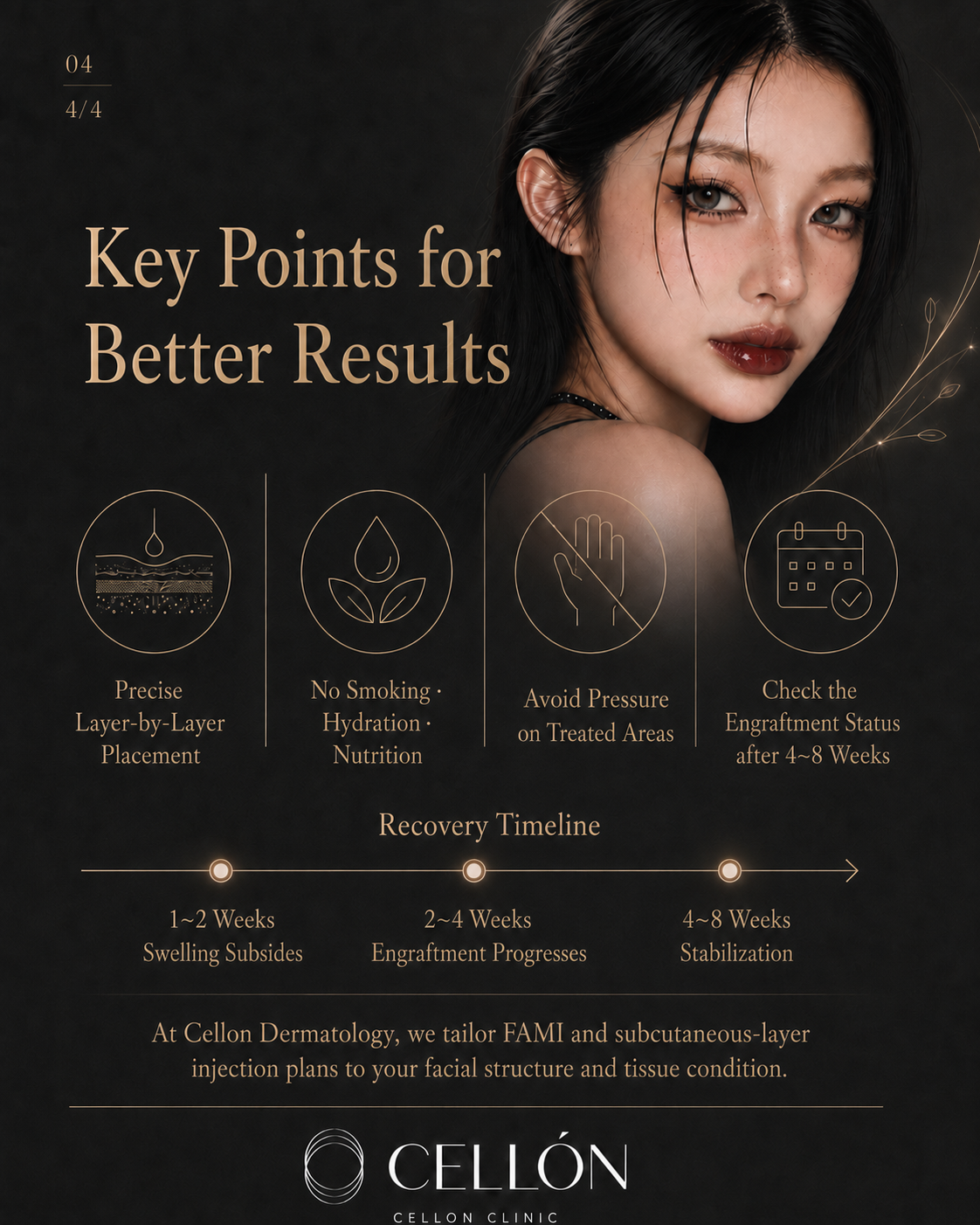
Smoking constricts blood vessels and reduces circulation, which can interfere with the angiogenesis process following fat transfer. Quitting smoking before your procedure helps create a more favorable environment for graft survival.
Pre-Treatment Care
Avoid Medications That Affect Circulation
Medications and supplements that affect blood clotting — such as aspirin and ibuprofen — may need to be paused for a period before your procedure. If you are currently taking any medications, please be sure to disclose them during your consultation.
Post-Treatment Care
Avoid Pressure on the Treated Area
During the early recovery phase, before the transferred fat cells establish vascular connections, applying pressure to the area can damage the cells. Activities such as sleeping face-down or direct massage should be adjusted in accordance with your care team's guidance.
Post-Treatment Care
Stay Hydrated and Well-Nourished During Recovery
It typically takes 2 to 4 weeks for the transferred cells to settle and stabilize. During this window, adequate hydration and a balanced diet help sustain the recovery environment your body needs.
Having realistic expectations about the recovery timeline is equally important. Immediately after the procedure, the combination of transferred fat and post-procedural swelling may make the treated area look overfilled — and then, within a few days, it may appear to deflate noticeably. This is a completely normal part of the healing process. Final results should only be assessed after the swelling has fully subsided and the grafted fat has stabilized, which is typically 4 to 8 weeks post-procedure. Knowing this in advance means you won't feel anxious about how things look in the interim — and you'll be able to move through your recovery with much greater peace of mind.
"The results of fat grafting aren't finalized on the day of the procedure — they take shape over the 4 to 8 weeks of recovery that follow. The face you see after the initial swelling has completely resolved is your true result. Our role is to help you understand that journey and walk through it with you."
— Dr. Kang Seung-hoon, Chief Physician, Cellon Clinic
Frequently Asked Questions
Q. How long does swelling last after fat grafting?
It varies by individual, but most noticeable swelling typically subsides significantly within 1–2 weeks. That said, subtle swelling and tissue settling continue over 4–8 weeks, so final results are best assessed after that period. Early on, the treated area may look overfilled or slightly asymmetrical — this is normal and generally resolves naturally as healing progresses.
Q. If the survival rate is low, will I need additional grafting?
Some degree of fat reabsorption is a medically expected outcome. Accounting for this from the outset — and planning the appropriate volume accordingly — is part of what a skilled specialist does. Depending on results, some patients may benefit from a touch-up session, which is determined through a follow-up consultation. The standard approach is to wait until the initial results have fully stabilized before making that call.
Q. Is FAMI fat grafting the right approach for everyone?
FAMI requires a precise understanding of facial anatomy and a high level of technical experience. It's not a one-size-fits-all technique — the optimal placement layer and approach are determined by each patient's facial structure, fat volume, and desired outcome. In many cases, FAMI is combined with subcutaneous-layer grafting for best results. Suitability is assessed through a thorough in-person consultation.
Q. How do I decide between fat grafting and fillers?
If you're looking for immediate results with a relatively straightforward recovery, fillers may be the better fit. If you want long-lasting, natural-looking volume, have concerns about foreign-body reactions, or are interested in regenerative benefits, fat grafting is worth considering. Keep in mind that fat grafting requires a sufficient donor site and a recovery period — both practical factors to weigh. In some cases, the two approaches are used together or in a staged sequence.
Q. What sets Cellon Clinic's approach to fat grafting apart?
As a Ministry of Health and Welfare–designated Designated Advanced Regenerative Medicine Hospital in Cheongdam, Cellon Clinic approaches fat grafting not simply as a volume procedure, but through the lens of regenerative medicine. This means a processing protocol designed to preserve the stem cell components within harvested fat, precise layer-by-layer placement tailored to each facial zone, and seamless integration with regenerative treatments such as Exosome and Rejuran therapy. Dr. Kang Seung-hoon personally handles every consultation and procedure, delivering a fully individualized treatment plan.

Cellon Clinic · Cheongdam Designated Advanced Regenerative Medicine Hospital
Have questions about fat grafting?
We're here to help.
We'll build a personalized plan tailored to your facial structure and goals.
Consultations are led personally by Medical Director Dr. Kang Seung-hoon.