
Laser Treatments: Are They Really
Bad for Your Skin?
Does the claim "laser treatments thin out your skin" scare you?
Here's the evidence-based answer. feat. IPL
The claim that laser treatments damage skin is only half true. More precisely, laser treatments work by inducing intentionally controlled micro-injuries that trigger your skin's natural healing and regenerative response. Without understanding this context, lasers can easily sound like a "dangerous procedure that burns your skin."
Many people visiting a dermatologist for the first time say, "I was too scared to come because I heard laser treatments thin out your skin." A single line read online, or a story from someone they know, has planted seeds of worry.
That concern isn't entirely unfounded. Incorrectly calibrated energy levels, improper treatment settings, and procedures performed without a licensed specialist can genuinely cause problems. However, that's not an issue with laser treatment itself—it's a matter of treatment environment and professional expertise.
Today, I'll walk you through the fundamentals, safety profile, and effectiveness of IPL (Intense Pulsed Light), the gold standard in laser treatments. After reading this, your perspective on laser therapy will likely shift.
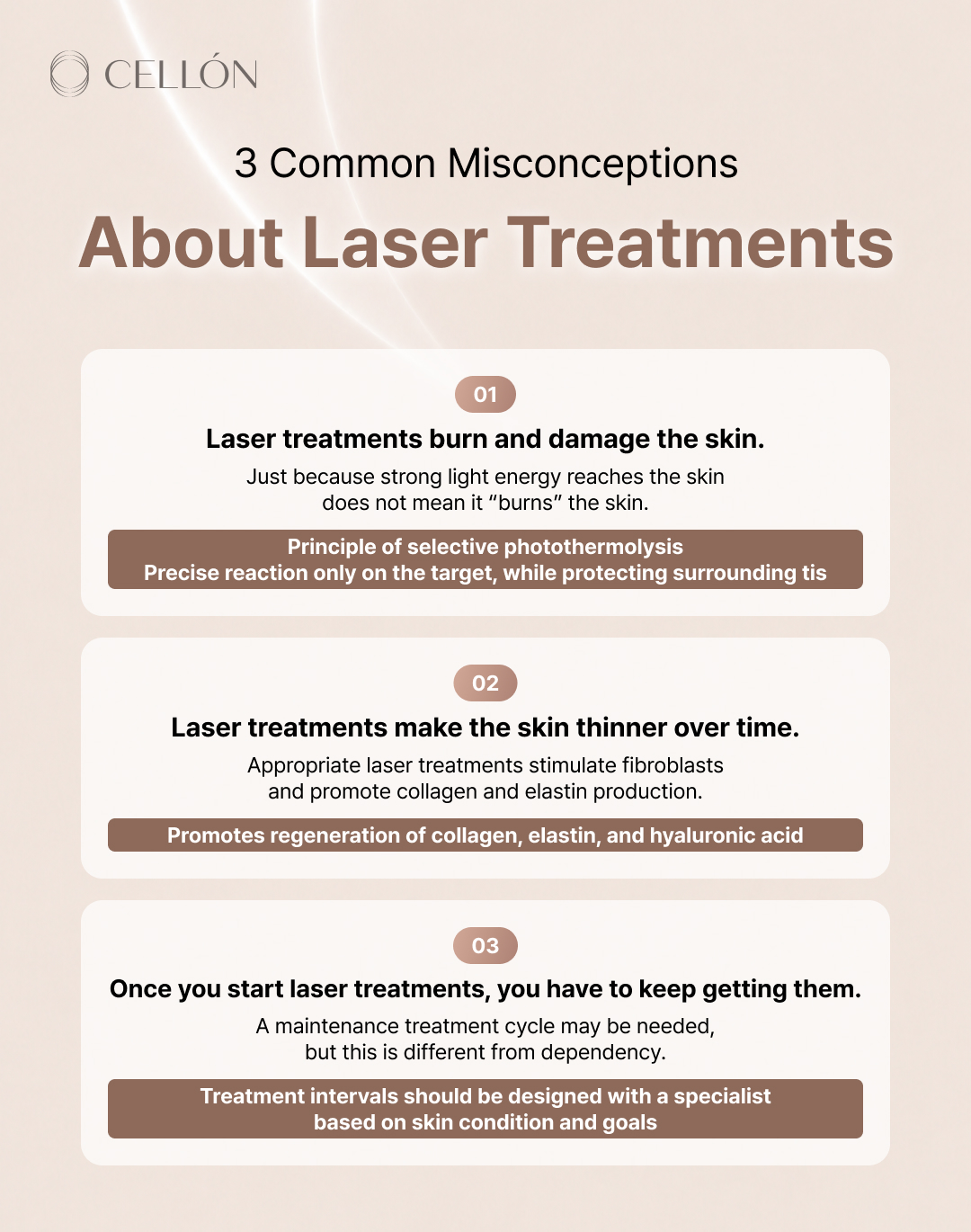
3 Common Misconceptions About Laser Treatment
Let's address the concerns that often make people hesitant about laser procedures.
Laser treatment burns and damages the skin
Just because intense light energy reaches your skin doesn't mean it's "burning" it. Lasers and IPL are designed so that specific wavelengths of light only react to specific targets (pigment, blood vessels).
Laser treatment gradually thins the skin
In fact, proper laser treatment stimulates fibroblasts to promote collagen and elastin production. The controlled micro-injury triggers a regenerative response in the skin. It's normal for skin to become thicker and more elastic after treatment.
Once you start, you have to keep getting treatments
Skin aging and pigmentation occur continuously in our daily lives. While maintenance treatments may be recommended at certain intervals, this is completely different from creating a dependency.
How IPL and Selective Photothermolysis Work
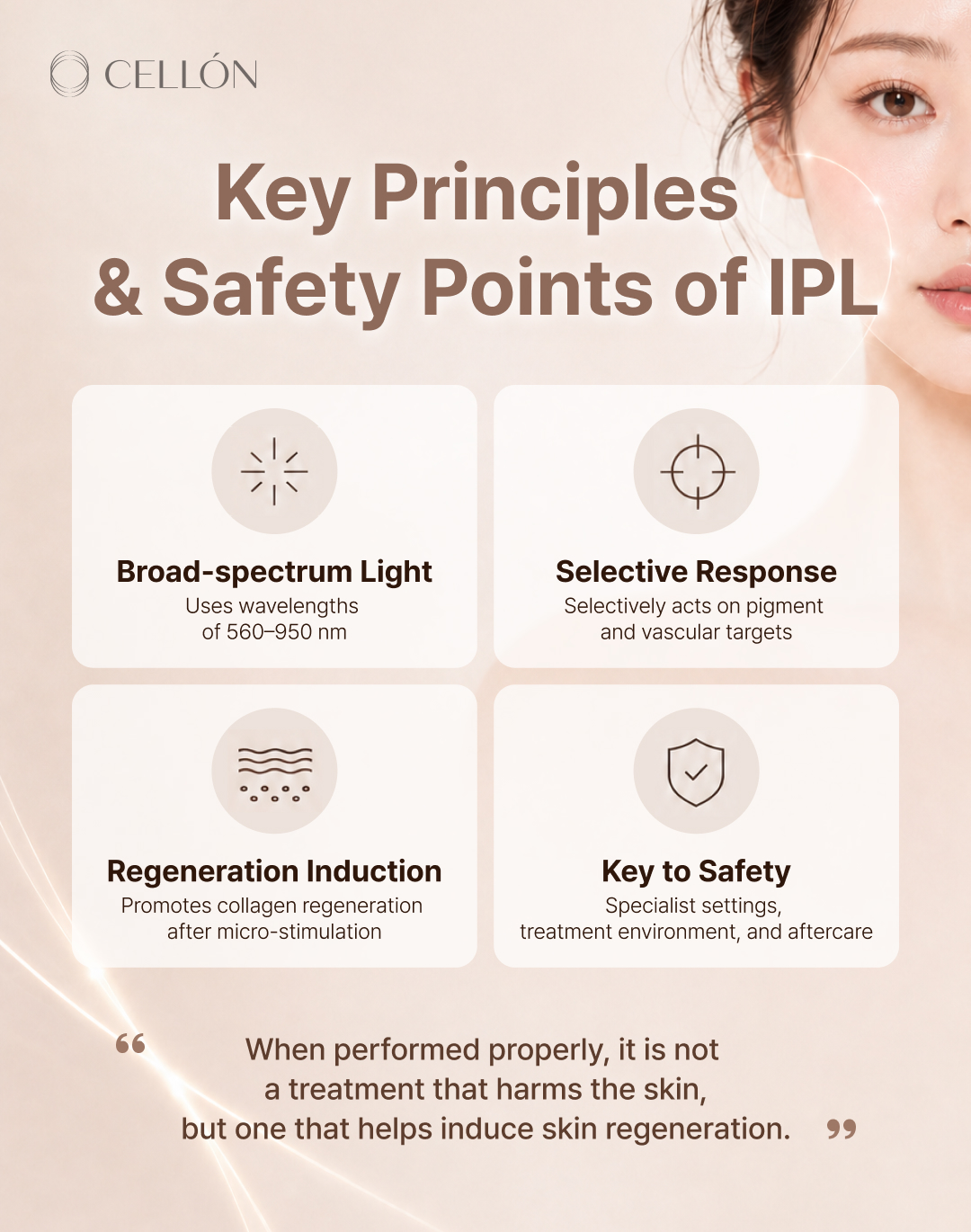
IPL stands for Intense Pulsed Light, and unlike traditional lasers that use a single wavelength, it harnesses a broad spectrum of light ranging from 560nm to 950nm. This wide wavelength range is one of IPL's major advantages, allowing it to simultaneously target both pigmented lesions (spots, melasma) and vascular lesions (redness, broken capillaries).
The core principle behind IPL's effectiveness is selective photothermolysis (SPT). Established by a Harvard Medical School research team in 1983, this principle is based on the physics that light of specific wavelengths is selectively absorbed only by specific chromophores.
The Selective Photothermolysis Principle — Key Concepts
The skin contains multiple chromophores that absorb light. The primary ones include melanin (pigment), hemoglobin (blood vessels), and water (dermis). Each chromophore has unique properties—they each absorb different wavelengths of light most effectively.
IPL leverages this characteristic by targeting pigmented lesions with wavelengths in the 500-600nm range and vascular lesions with wavelengths primarily in the 560-700nm range. In other words, the light doesn't uniformly damage the entire skin surface. Instead, it precisely selects only the problematic targets and concentrates energy on them.
When the target absorbs light energy, heat is generated, and that heat destroys the target tissue. The critical point is that the energy delivery must be completed before heat diffuses from the target to surrounding tissue—this time window is called the 'thermal relaxation time.' IPL calculates this duration and delivers energy in brief pulses, minimizing damage to adjacent healthy tissue.
Part of the claim that "lasers damage skin" originates here. It's true—IPL and laser treatments intentionally create thermal damage to target tissue. However, this damage isn't indiscriminate destruction; rather, it's a 'controlled injury' designed to awaken the skin's natural regenerative abilities.
When microscopic damage occurs, the skin immediately initiates a healing response. Fibroblasts become activated, and synthesis of collagen, elastin, and hyaluronic acid increases. This is why skin texture improves after treatment, firmness increases, and a natural radiance emerges.
IPL Treatment: What Happens Inside Your Skin
From the moment light touches your skin to the completion of regeneration — follow the 5-stage process.
Broad-Spectrum Light Application (560~950nm)
The IPL handpiece makes contact with your skin, and broad-spectrum light in the 560nm~950nm range is delivered in short pulse intervals. By exchanging cut-off filters, wavelength bands are selectively targeted to your specific concerns. You may feel a mild tingling sensation during treatment, and depending on the device, integrated cooling systems maintain stable skin surface temperature throughout the procedure.
Selective Light Absorption by Chromophores (Targets)
Each chromophore — including melanin and hemoglobin — selectively absorbs light energy at its corresponding wavelength. In pigmented areas, melanin concentrates the energy absorption; in areas with redness, hemoglobin does. Surrounding healthy tissue that doesn't absorb this energy shows minimal response at this stage.
Photothermal Reaction — Heat Generation in Target Tissue
Absorbed light energy converts into heat. This heat rapidly rises within the chromophore (target) tissue, and because energy delivery completes within the thermal relaxation time (TRT), the heat concentrates in the target before diffusing to surrounding areas. This precise timing control is the physics-based foundation of IPL safety.
Target Destruction — Pigment Breakdown or Vessel Coagulation
In pigmented lesions, melanin breaks down into small particles that are naturally eliminated by immune cells (macrophages) in the body. In vascular lesions, hemoglobin denatures from heat, vessels coagulate, and are naturally reabsorbed. This is why pigmented spots crust over and shed within days after treatment.
Regeneration Phase — Fibroblast Activation
Upon receiving micro-injury signals, your skin immediately shifts into regeneration mode. Fibroblasts actively synthesize collagen, elastin, and hyaluronic acid, and over several weeks, skin structure remodels. Post-treatment skin care during this phase — UV protection, hydration, and minimizing irritation — is the final key to achieving optimal results.
Proper Treatment vs. Complications
Safety with laser and IPL treatment depends less on the technology itself and more on the environment and approach—how and where you receive it matters most.
Safe and Effective Treatment
- Board-certified dermatologist personally evaluates skin type and tone before setting energy parameters
- Wavelength, energy, and pulse width selected based on Fitzpatrick skin type classification
- Comprehensive pre-treatment consultation covering medications, skin history, and photosensitivity screening
- Epidermal protection through cooling devices and appropriate cooling gel application
- Post-treatment skin recovery guidance—sun protection, hydration, and activity restrictions
- Adequate spacing (typically 3–4 weeks) between sessions to allow complete skin recovery
When Complications Arise
- Identical energy settings applied to all patients regardless of skin type
- Excessively high energy settings used to achieve faster results
- Repeated treatments at short intervals, ignoring necessary skin recovery time
- Treatment during photosensitizing medication use or immediately after tanning
- Post-treatment outdoor activity without sun protection—dramatically increased risk of hyperpigmentation
- No physician supervision—inability to address complications immediately if they occur
Ultimately, the safety and efficacy of laser and IPL treatment depend far more on the physician's judgment, parameter settings, and pre- and post-treatment care than on the device itself. Skin type and energy customization are critical to safety—which is precisely why treatment must be performed by a qualified dermatologist. Even with identical IPL equipment, results can vary dramatically based on how the settings are configured.
East Asian skin (including Korean skin, typically Fitzpatrick Scale III–IV) has higher melanin content and can respond sensitively to IPL energy. This is why receiving treatment from a board-certified dermatologist with experience using protocols optimized for Korean and East Asian skin is so important.
Key Data on IPL Treatment
Here are the numbers that support the science and effectiveness behind IPL.
Utilizes broadband spectrum up to 950nm
Based on standard course (1 session per month)
Recommended to reflect skin regeneration cycle
Standard for pigment clearance and renewal completion
Harvard Medical School - Anderson & Parrish
Noticeable improvement in skin elasticity
What IPL Can Address All at Once
One of the greatest advantages of IPL is its ability to address multiple skin concerns simultaneously in a single treatment. From pigmentation and vascular lesions to skin elasticity — the broad wavelength spectrum of IPL makes this possible.
Pigmentation Issues — Sunspots, Melasma, Dullness
When melanin is overproduced due to UV exposure, hormonal changes, and aging, it accumulates in the upper layers of the skin, resulting in sunspots, melasma, and uneven skin tone. IPL's 500–600nm wavelength range is selectively absorbed by melanin, destroying pigment particles and allowing them to fade through the skin's natural elimination process. It's normal for pigmentation to appear temporarily darker immediately after treatment — this is caused by melanin fragments rising toward the epidermis, which then naturally shed over time.
Vascular Issues — Redness, Broken Capillaries, Flushing
Facial redness and dilated capillaries improve as IPL's 560–700nm wavelength reacts with hemoglobin. The vessel walls coagulate from the heat and are naturally absorbed by the body. Since this closes off the blood vessels themselves, it's particularly effective for early-stage rosacea, cheek redness, and broken capillary reduction.
Elasticity Improvement — Collagen & Elastin Remodeling
IPL's longer wavelength range (700–950nm) acts on moisture and fibroblasts in the dermis. When this energy reaches the dermal layer, fibroblasts activate, increasing collagen, elastin, and hyaluronic acid synthesis. Rather than immediate results, these changes develop gradually over several weeks, smoothing skin texture and restoring natural elasticity. This simultaneous improvement in pigmentation, vascular issues, and elasticity is precisely why IPL's multi-wavelength technology is so effective.
The importance of post-treatment skincare management cannot be overstated. Apply broad-spectrum sunscreen daily and generously before going outside. For 1–2 weeks after treatment, avoid harsh cleansers and exfoliants, as your skin is actively regenerating. Providing adequate hydration and nourishment during this critical period enhances the results significantly.
"To patients who say they're nervous about laser treatment, I always explain it this way: Our bodies have an inherent ability to heal themselves, and lasers simply send a signal to awaken that ability. The key lies in how precise and appropriate that signal is. When treatment is performed with careful skin-type assessment, individualized energy settings, and proper recovery intervals, it's not damaging the skin — it's restoring the skin's natural power to heal itself."
IPL Treatment Frequently Asked Questions
We've compiled the most common questions from our consultations.
Wondering which treatment is right for your skin?
Find out at CELLON Dermatology
Laser and IPL treatments are customized based on your skin type, current condition, and desired results. At CELLON Dermatology, we thoroughly evaluate your skin and design a personalized treatment plan that's perfect for you.