Why Do Sili Lifting Side Effects Happen?
How Triple-Lock Sili Lifting Takes a Different Approach
Uneven skin texture, asymmetry, threads that feel like they're poking through — these are concerns many people have after Sili Lifting. Understanding what causes side effects in the first place can completely change how you make your decision.
Thread Lifting: Does It Actually Work?
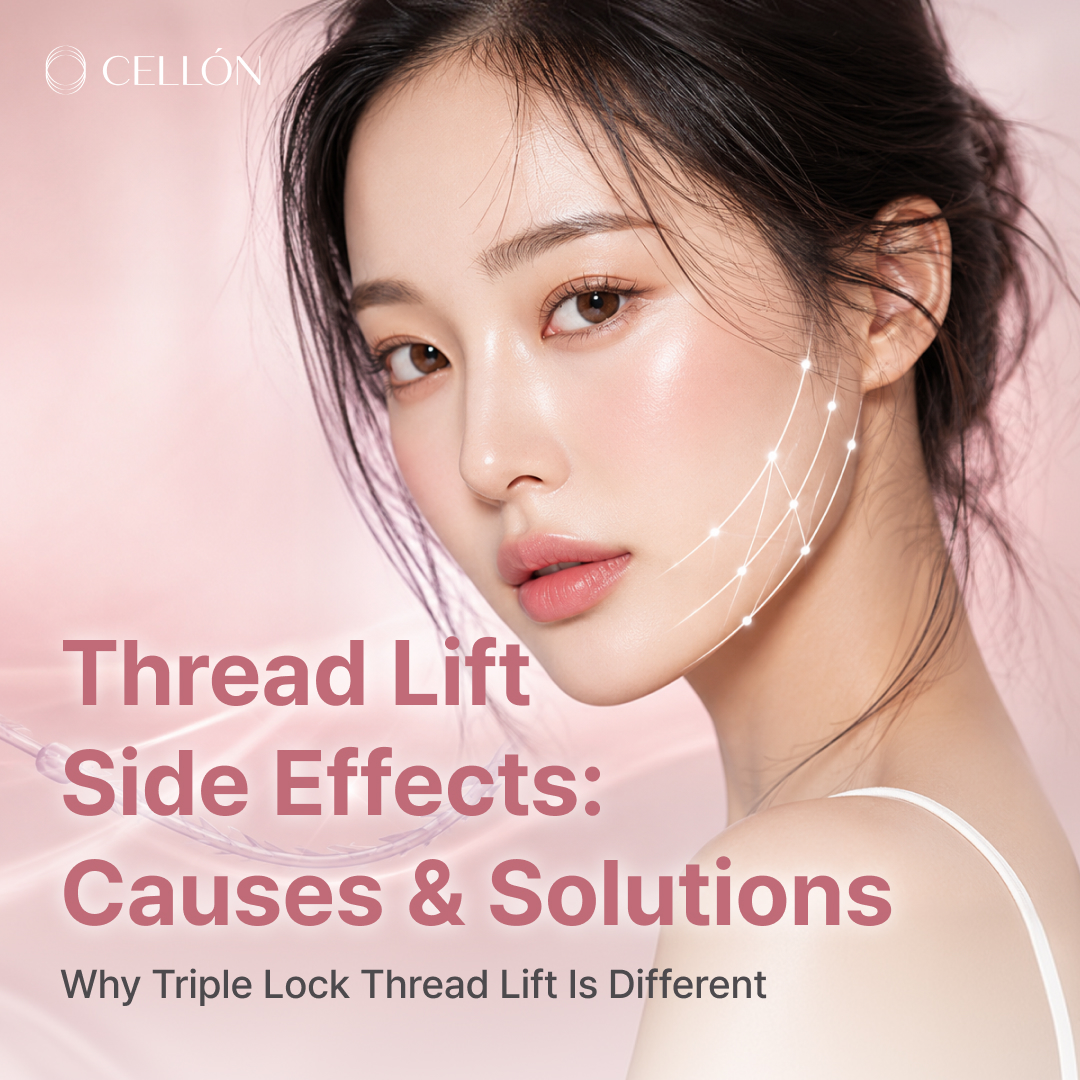
Thread lifting is a minimally invasive procedure in which specially designed threads are inserted beneath the skin to lift sagging tissue and stimulate collagen production. Because it delivers visible lifting results without surgery, it has remained one of the most sought-after anti-aging treatments for years.
At the same time, a quick search for "thread lifting side effects" turns up a wide range of experiences. Uneven skin texture, visible or palpable threads, asymmetry, and results that fade too quickly — these outcomes understandably raise concerns. So why do these side effects occur? And do all thread lifting procedures carry the same risks?
In this article, we'll take a closer look at the structural reasons behind thread lifting side effects, and explain how the Triple Lock Thread Lifting performed at Cellon Clinic addresses these issues.
Thread Lifting Side Effects: Two Main Causes
Insufficient Thread Anchoring
Unidirectional or simple-structure cog threads may feel lifted immediately after insertion, but if they fail to anchor securely within the tissue, the threads can loosen or migrate within weeks to months. When threads migrate, the skin surface can become uneven or develop a pulling sensation, and the lifting effect fades quickly. Without a solid anchoring structure, the longevity of the lifting result is inevitably compromised.
Inadequate Insertion Depth and Vector Design
If threads are inserted too superficially, they may become visible beneath the skin surface or create irregular contours after the procedure. Conversely, inserting them too deeply or at a vector that doesn't align with the facial structure can result in unnatural tension, dimpling, or asymmetry. Because the left and right sides of the face have subtly different anatomical structures, asymmetric outcomes are likely without a personalized vector plan.
Common Types of Thread Lift Side Effects and How to Address Them
Side effects following a thread lift procedure can generally be divided into short-term and medium-to-long-term categories. Knowing the causes and how to address each one can be very helpful.
1. Skin Surface Irregularities (Dimpling)
Some temporary dimpling or unevenness immediately after the procedure is normal as the threads settle into position. This typically resolves on its own within 2–4 weeks. However, if the threads were inserted too superficially or have shifted, the irregularities may not improve even after several weeks. In such cases, a specialist evaluation may be needed, along with thread repositioning or additional treatment.
2. Palpable or Exposed Threads
If the insertion depth is uneven or the threads have migrated, you may be able to feel them under the skin—and in rare cases, they may even protrude through the skin's surface. Any exposed thread must be treated by a specialist without delay, as leaving it untreated significantly increases the risk of infection.
3. Asymmetry
This occurs when the two sides of the face are pulled unevenly or show a difference in lifting effect. Natural anatomical facial asymmetry, variations in thread insertion vectors, and individual tissue responses all play a role. This is exactly why thorough pre-procedure design and personalized treatment planning are so important.
4. Results That Fade Too Quickly
"It looked great right after, but within two months it was back to where it started." This kind of experience typically happens when threads with insufficient anchoring strength are used, or when the number or direction of threads is inadequate. Thread lift results depend not only on the physical tension of the threads themselves, but also on their ability to stimulate new collagen production—making the structural design of the threads and the overall treatment plan absolutely critical.
5. Bruising, Swelling, and Sensory Changes
Temporary bruising and swelling are common when threads are inserted into the highly vascular facial area. Most cases resolve within 1–2 weeks, though proper aftercare during the recovery period is important. In the rare event of sensory changes, the practitioner's precise anatomical knowledge of facial nerve pathways becomes especially critical.
Three Structural Mechanisms That Minimize Side Effects in Triple-Lock Thread Lifting
The Triple-Lock Thread Lifting performed at Cellon Clinic integrates three distinct anchoring mechanisms to address the limitations of conventional single-cog threads. Here's how each stage works.
First Lock — Dermal Anchor Point
A firm anchor point is established deep within the dermis at the thread's starting position. When this initial fixation is weak, the entire lifting vector becomes unstable — so the more secure this first lock, the greater the overall holding power of the thread. Placing the anchor point precisely at the correct tissue depth is a direct reflection of the practitioner's skill and experience.
Second Lock — Multi-Directional Cog Structure
Unlike standard unidirectional cog threads, the multi-directionally arranged cogs (micro-barbs) interlock with the fibrous tissue inside the skin from multiple angles. This structure minimizes thread migration and promotes stable tissue integration. The higher the density and multi-directional arrangement of the cogs, the lower the chance of thread displacement — and the broader the area stimulated for new collagen production.
Third Lock — Terminal Fixation Point
An additional fixation point is created at the far end of the thread, resulting in a structure that is "anchored at both ends." A thread fixed at only one end gradually shifts under tension, whereas a dual-end anchor maintains the thread's position over the long term. This three-stage locking system is the core principle behind the name Triple-Lock.
"The outcome of a thread lift is determined not by the brand of thread, but by three factors: insertion depth, vector design, and anchoring structure. The same thread can produce completely different results depending on how it's placed."— Dr. Kang Seung-hoon, Chief Medical Director, Cellon Clinic
When Triple-Lock Thread Lifting Works Best
In your mid-30s to 40s, as cheek tissue begins to descend and nasolabial folds deepen, vector lifting helps reposition the sagging tissue back where it belongs. Rather than adding volume with fat grafting or fillers, this approach focuses on restoring what's shifted out of place.
When the boundary between your jaw and cheeks becomes blurred and the lower face looks heavy, a carefully designed lower-face vector can help restore a sharper, more defined contour. Thread Lifting is a practical non-surgical option for anyone looking to bring their jawline back into focus.
If your previous thread lift results have faded or didn't meet your expectations, Triple-Lock Thread Lifting may still be a viable option. A customized plan that accounts for the absorption of prior threads and the current state of your tissue structure is essential for the best outcome.
Beyond the physical lifting effect, threads also stimulate new collagen production in the surrounding tissue. When combined with regenerative treatments such as Exosome or Rejuran therapy, you can expect improved skin elasticity on top of the lift itself. Cellon Clinic is a Cheongdam-based Designated Advanced Regenerative Medicine Hospital, uniquely positioned to offer this integrated approach.
What to Confirm Before Your Thread Lifting Treatment
Precisely targeting the dermis-SMAS boundary layer is essential to prevent surface irregularities.
Lifting vectors should be individually designed based on your facial structure and the direction of sagging to minimize asymmetry.
It's important to confirm whether the thread fixation method is sufficiently stable — whether it uses unidirectional or multi-point anchoring.
Our Approach to Thread Lifting at Cellon Clinic
Cellon Clinic is a Cheongdam Designated Advanced Regenerative Medicine Hospital, recognized by the Ministry of Health and Welfare. We offer not only standalone thread lifting, but also integrated approaches combining regenerative treatments such as Exosome and Rejuran therapy.
Triple-Lock Thread Lifting isn't simply about using "better threads." The key lies in customizing insertion depth, vector direction, and anchor point placement to match each patient's unique facial structure. Our head physician, Dr. Kang Seung-hun, personally handles both consultations and procedures, ensuring a consistent and seamless care experience from your first visit through to treatment.
For cases where thread lifting alone cannot fully address volume loss, we may recommend combining the procedure with fat grafting or filler. A combined approach that addresses both lifting and volume tends to produce results that look more natural and last longer.
If you're concerned about thread lifting side effects, or if a previous procedure didn't give you the results you hoped for, we recommend starting with an accurate assessment of your current condition. The most appropriate treatment plan can vary significantly depending on your individual situation.
Frequently Asked Questions (FAQ)
Concerned About Silhouette Lift Side Effects?
The first step is understanding your current condition accurately. At Cellon Clinic Cheongdam, a Designated Advanced Regenerative Medicine Hospital, Medical Director Dr. Kang Seung-hoon will personally consult with you. Feel free to reach out via WhatsApp anytime.
Chat with Us on WhatsApp