
Thermage FLX 600 Shots vs. 900 Shots
Which One Is Right for Your Face?
More shots don't automatically mean better results. The ideal shot count depends on your facial surface area, skin condition, and treatment goals. Dr. Kang Seunghoon of Cellon Clinic breaks it all down for you.
What Is Thermage FLX? Let's Break It Down Once and for All

Thermage FLX is a radiofrequency (RF) lifting device that delivers energy deep into the skin to stimulate collagen contraction and regeneration. "FLX" stands for Flexible — and compared to earlier generations of Thermage, it works faster and offers a more comfortable experience. What sets it apart is its ability to deliver targeted thermal energy deep into the skin layers (dermis to SMAS layer) without any incisions.
"Thermage isn't some magic treatment that turns back the clock ten years overnight. It works by gradually stimulating collagen remodeling deep within the skin — which is why results often look even better at the 3–6 month mark than right after the procedure. Setting realistic expectations about timing is really important."
— Dr. Kang Seung-hun, Cellon Clinic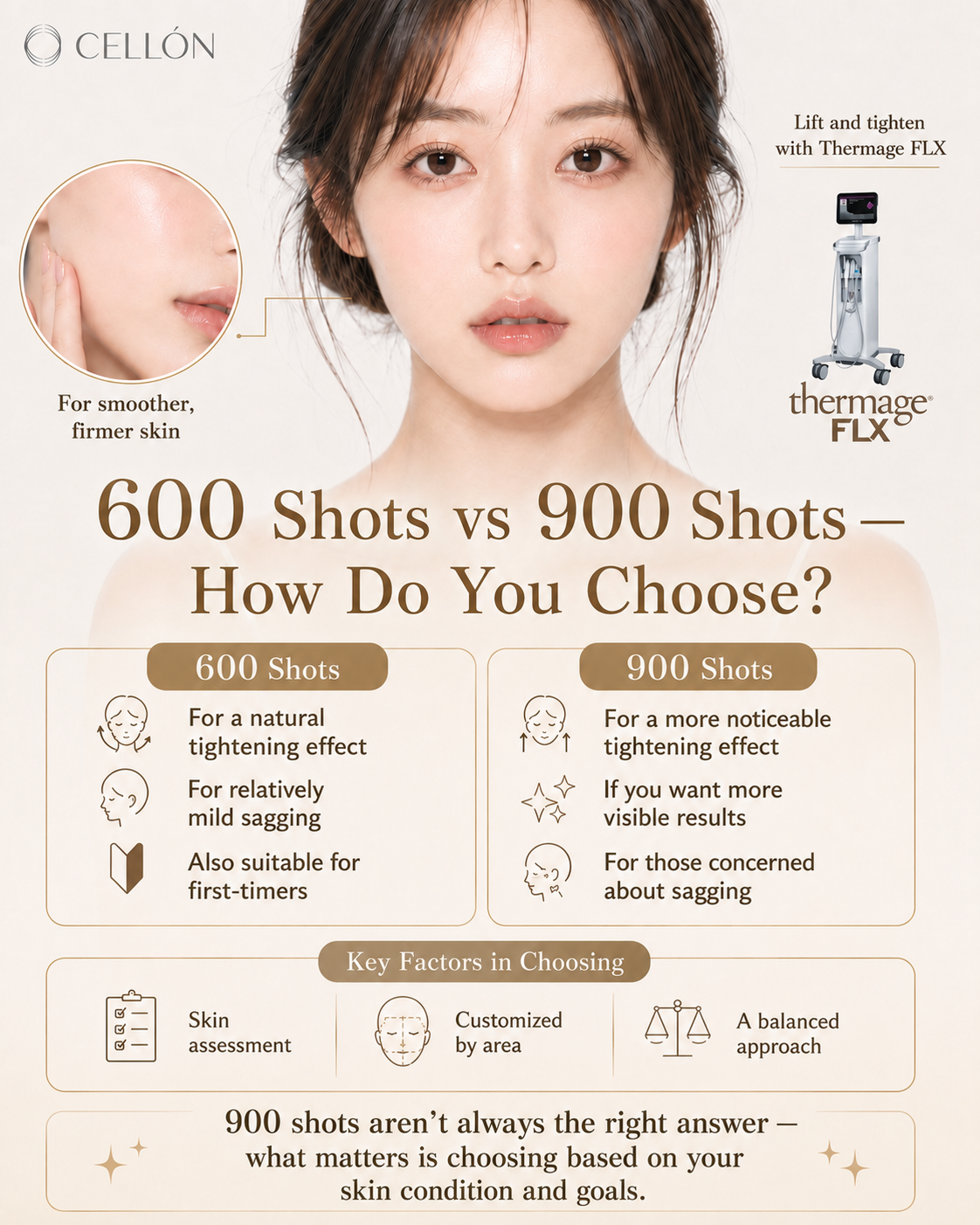
How Is the Shot Count Decided? Dr. Kang's Criteria
"Is it 600 shots or 900 shots?" — I get this question multiple times a day. Shot count isn't just a numbers game. I base my decision on three key factors.
Facial Size and Structure
Patients with a larger face or a longer, wider jawline naturally require more shots to cover the same areas. On the other hand, those with a smaller face can often achieve full coverage with 600 shots. The number also changes depending on which areas are included — forehead, eye area, cheeks, or neck.
Degree of Skin Laxity and Age
For patients in their early 30s with only mild loss of elasticity, 600 shots can often deliver the desired improvement. However, for those in their late 40s to 50s with more visible sagging, or those seeking full cheek lifting, 900 shots or more is frequently recommended.
Treatment Goals and Target Areas
If you're looking for a partial lift focused on the eye area and forehead, a targeted treatment with fewer shots is entirely possible. A full-face treatment that extends to the neck and décolletage will naturally call for a higher shot count. Whether the goal is "maintenance" or "active improvement" is also an important factor in my recommendation.
"I always tell patients in the consultation room: more shots doesn't automatically mean better results. Delivering excessive energy relative to the skin's condition can actually cause skin damage or pigmentation issues. The key is maintaining the right energy level and achieving the best possible outcome within the range the skin can safely handle."
— Dr. Kang Seung-hoon, Cellon Clinic600 Shots vs. 900 Shots — What's the Real Difference?
Here's a side-by-side look at the two most popular options. See which one sounds more like you.
600 Shots
Partial Lifting / Maintenance- Smaller facial surface area
- Early-to-mid 30s with early signs of skin laxity
- Targeted treatment on specific areas like cheeks or eye contours
- Previous Thermage experience and looking to maintain results
- Relatively shorter treatment time
900 Shots
Full-Face Lifting / Comprehensive Improvement- Larger face or wider jawline
- 40s and above with visible sagging to address
- Full-face treatment including the neck
- First-time treatment with a goal of more dramatic improvement
- Needs broader coverage across multiple areas
Beyond 600 and 900 shots, Thermage FLX also offers a 450-shot option focused on the eye area, as well as full-body protocols of 1,200 shots or more. The best choice really depends on your skin condition at the time of your consultation — our doctor will assess you in person and recommend the most suitable option.
Thermage FLX Results & Precautions — Expectations vs. Reality
One of the biggest questions people have about Thermage is just how dramatic the results will be. Here's an honest breakdown of what you can realistically expect.
When Results Appear
You may notice some immediate tightening right after the procedure. The collagen-stimulating effects, however, gradually develop over the following 3 to 6 months. Rather than judging results too quickly, it's important to monitor progress over time.
How Skin Type Affects Response
Those with thicker skin or higher collagen density tend to respond more favorably. On the other hand, extremely thin skin or underlying medical conditions may require energy level adjustments for a safe and effective treatment.
Downtime & Recovery
There is generally little to no significant downtime. Some temporary redness or mild swelling may occur, but this typically subsides within the same day or within a few days. It's best to avoid intense sun exposure and saunas following the procedure.
Complementary Treatments
Thermage FLX on its own can deliver meaningful Lifting results, but combining it with skin regeneration or hydration treatments — such as Rejuran or Exosome therapy — can further optimize the environment for collagen renewal. The best combination for your skin will be discussed during your consultation.
"Thermage FLX is clearly an effective option for addressing sagging skin. That said, if you're expecting a dramatic transformation, an honest consultation comes first. Even with the same number of shots, outcomes can vary significantly depending on energy levels and treatment patterns. That's why I place more emphasis on how precisely the energy is delivered than on the numbers alone."
— Dr. Kang Seung-hoon, Cellon Clinic
Getting Thermage FLX at Cellon Clinic
Cellon Clinic is a Ministry of Health and Welfare-designated Cheongdam Designated Advanced Regenerative Medicine Hospital. All Thermage FLX consultations and treatments are performed directly by Chief Director Dr. Kang Seung-hoon. Here's a simple overview of what to expect from the process.
Initial Consultation — Skin Assessment
We evaluate the degree of skin laxity, facial structure and surface area, and your treatment history. This helps us determine whether Thermage FLX is the right option for your current skin condition, or whether a different approach may be more suitable.
Shot Count & Energy Level Planning
Based on your consultation, we design a customized plan including shot count (e.g., 600 or 900 shots) and energy levels for each treatment zone. Even with the same shot count, energy settings are adjusted according to skin thickness and the specific areas of laxity.
Treatment Session
A topical anesthetic cream is applied before the procedure begins. The FLX generation features a faster delivery speed compared to previous versions, reducing overall treatment time. Comfort levels are monitored throughout and adjusted in real time as needed.
Post-Treatment Guidance & Follow-Up
After the procedure, we provide detailed aftercare instructions and lifestyle recommendations. Results are assessed together at the 3–6 month mark, and further treatment options are discussed if needed. The same standard of care applies to both domestic and international patients.
Frequently Asked Questions — Answered by Dr. Kang Seung-hun
Here are the questions we hear most often in our consultations.

Thermage FLX — Wondering How Many Shots Are Right for You?
We'll take a close look at your facial area, skin condition, and treatment goals,
and Dr. Kang Seung-hun will guide you toward the best option for your needs.
Send us a message at Cheongdam Cellon Clinic to get started.